A sewage backup is one of the most distressing water damage events a Phoenix homeowner can experience — and one of the most dangerous to handle without professional help. Unlike a clean water pipe burst or an appliance overflow, sewage backup water is classified as Category 3 black water: it contains bacteria, viruses, parasites, and chemical contaminants that pose serious health risks from contact, inhalation, or ingestion.
Health Risks of Sewage Backup in Phoenix Properties
Sewage water contains a broad spectrum of pathogens that cause serious illness in exposed individuals. Bacteria commonly present include E. coli, Salmonella, Campylobacter, and Shigella — all capable of causing severe gastrointestinal illness from contact with skin, eyes, or mucous membranes, or from incidental ingestion.
The vapor and aerosol risks of sewage backup are often underestimated. When sewage water is agitated — even by something as simple as walking through it — aerosolized particles containing pathogens become airborne and can be inhaled or settle on surfaces throughout the property.
What Causes Sewage Backups in Phoenix
Municipal sewer line blockages are the most common cause of sewage backup events in Phoenix. The municipal sewer system accumulates grease, debris, and non-flushable materials that create blockages in lateral lines. OSHA details the safety hazards workers face during flood cleanup.
Root intrusion from mature trees is a leading cause of sewage backup in residential properties across Phoenix. Desert trees — particularly the large mesquite, palo verde, and eucalyptus trees common in established Phoenix neighborhoods — develop extensive root systems that seek moisture.
Private line failures — collapse, offset joints, or complete blockage of the homeowner's sewer lateral between the house and the municipal connection — are the homeowner's financial responsibility to repair. A collapsed lateral can cause immediate backup with no warning.
The Professional Sewage Cleanup Process
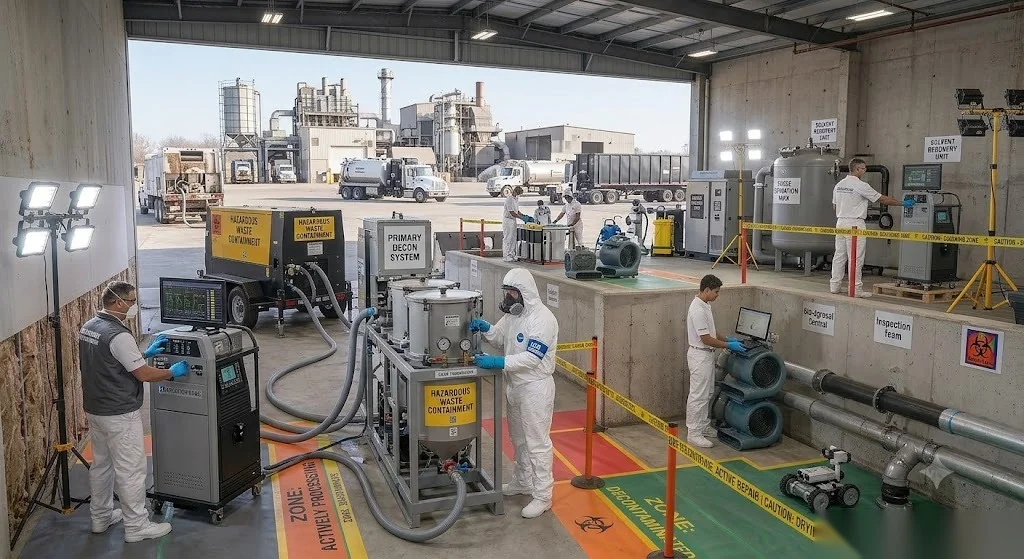
Category 3 cleanup begins with full containment of the affected area before any extraction begins. Plastic sheeting barriers are established around the perimeter of the sewage-affected zone, and the area is placed under negative air pressure using HEPA air scrubbers — this prevents contaminated air from flowing into unaffected areas of the property during the cleanup process. CDC guidance on mold cleanup after a disaster covers safe mold cleanup practices after a flood or storm.
Sewage extraction uses specialized equipment that is decontaminated after each use. Unlike clean water extraction, the equipment and disposal process must account for the hazardous nature of the waste.
After extraction and demo, the multi-stage decontamination process begins. Hard, non-porous surfaces — concrete floors, ceramic tile, metal fixtures — are first cleaned of all visible organic material, then disinfected with EPA-registered biocide solutions applied at the correct concentration and maintained at the required dwell time to achieve full pathogen elimination on that specific surface.
Insurance Coverage for Sewage Backup in Arizona
Here is the coverage reality that surprises many Phoenix homeowners: sewage backup is specifically excluded from most standard Arizona homeowners policies. Unlike a burst supply pipe or an appliance overflow, sewage backup damage — even from a municipal line failure that is entirely outside the homeowner's control — typically requires a specific endorsement to be covered. the IICRC S500 standard sets the procedural benchmark restoration companies are expected to follow.
If you have sewer backup coverage, the claim process typically covers the cost of sewage extraction, decontamination, demolition of non-salvageable materials, structural drying, and restoration of the affected space. Contents damaged by sewage backup may be covered under your personal property coverage, subject to the contamination exclusions specific to your policy.
Even without sewer backup coverage, other portions of your claim may be covered. If the sewage backup caused additional damage to adjacent areas that were covered by clean water — for example, if the backup caused an overflow that sent clean tap water into an adjacent room — the clean-water portion of the damage may be separately covered.