Commercial water damage in Phoenix operates on a different scale than residential — the affected area may be larger, the equipment at risk more expensive, the regulatory documentation requirements more complex, and the cost of lost operations immediate and quantifiable. A flooded Phoenix office building, retail store, or warehouse means halted productivity, potential inventory loss, disrupted client service, and the compounding cost of every hour that operations are not running.
Immediate Commercial Response Protocol
The moment a water damage event is discovered in a commercial Phoenix property, two calls need to happen simultaneously: a call to your water damage restoration company and a call to your property insurance carrier. Starting these processes in parallel rather than sequentially can save 24–48 hours in the overall timeline.
Protect critical business assets in the first hour. Business data — servers, network equipment, backup drives, and workstations — should be prioritized for relocation out of the affected area before water reaches them.
Scaling the Response to Commercial Floor Plates
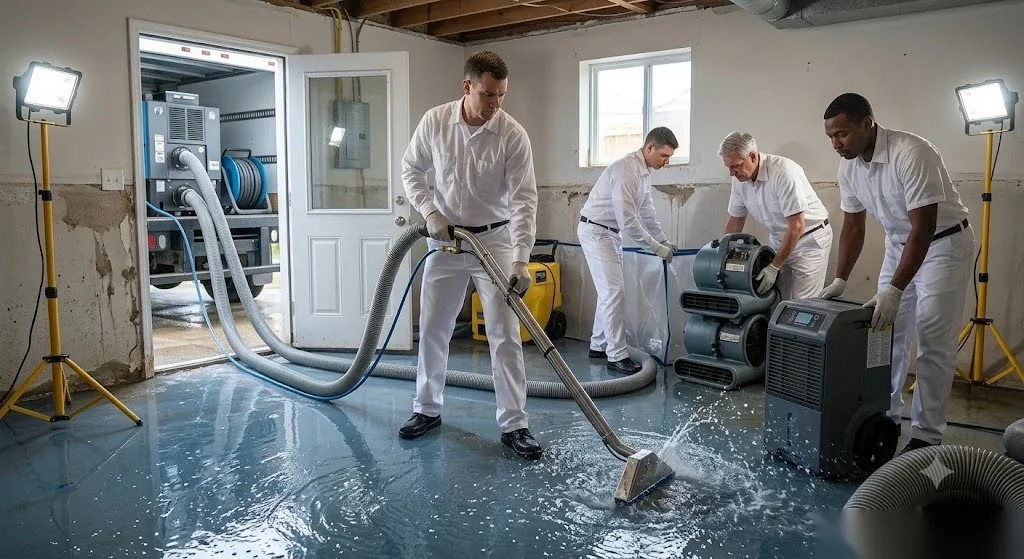
Commercial water damage restoration requires a fundamentally different equipment scale than residential. A 10,000-square-foot retail floor plate cannot be effectively dried with the same equipment load used in a 2,000-square-foot home. OSHA details the safety hazards workers face during flood cleanup.
Crew size is equally important. Extraction of a large commercial floor plate needs to happen as rapidly as possible to minimize saturation depth — a four-person crew extracts four times faster than a one-person crew, which directly reduces the overall scope of structural damage.
Phased restoration planning is the key to keeping commercial operations running during mitigation. When the entire affected area cannot be restored simultaneously, our team works with facility managers to prioritize areas by operational importance — restoring revenue-generating spaces first, then support spaces.
Insurance and Business Interruption Claims
Commercial property insurance policies covering Phoenix businesses typically include Business Interruption (BI) coverage — a provision that compensates for lost revenue, ongoing operating expenses, and extra expenses incurred as a result of a covered water damage event. BI coverage is triggered when a covered property damage event prevents or limits your normal business operations. the Insurance Information Institute breaks down what standard homeowners policies do and do not cover for water damage.
BI claims require specific documentation that your restoration company can help you organize: a timeline of the event from discovery through restoration completion, records of daily operations compared to normal operations during the affected period, records of any extra expenses incurred (temporary space rental, equipment rental, overtime for employees working around the damage), and revenue records establishing the business's normal income for the corresponding period in prior years. The more complete and organized this documentation, the smoother the BI claim resolution.
The relationship between your restoration company's timeline and your BI claim is direct: every day your facility is unusable is another day of BI exposure. Maximally aggressive mitigation — even if it costs more in equipment deployment — often saves money on the BI side by shortening the restoration period.
After the Emergency: Preventing the Next Event
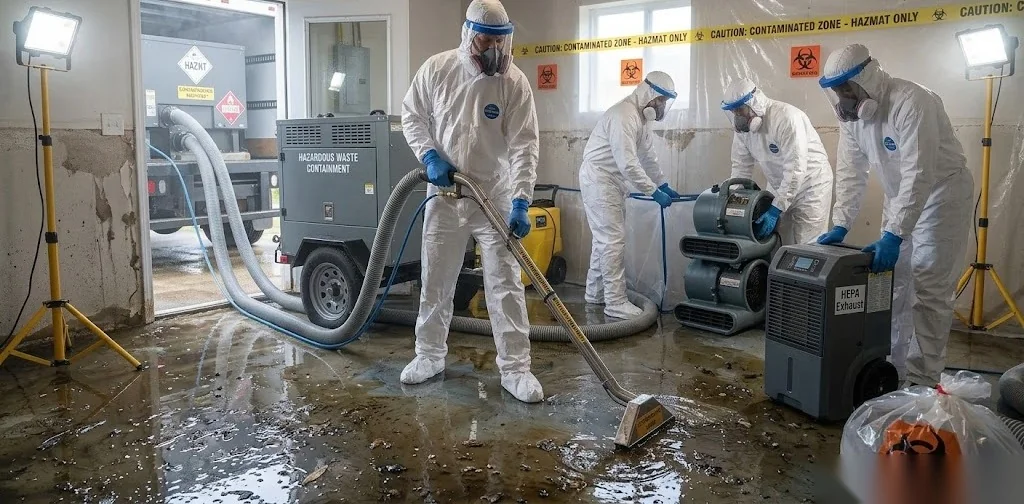
Post-event prevention is often overlooked in the relief of returning to normal operations, but commercial properties that experience one water damage event are statistically more likely to experience another if the underlying vulnerabilities are not addressed. Commission a comprehensive plumbing and roof inspection after every water damage event — the event may have revealed pre-existing conditions in adjacent areas that have not yet failed. the IICRC S500 standard sets the procedural benchmark restoration companies are expected to follow.
Install water detection sensors at high-risk locations in your commercial Phoenix property: near water heaters and boilers, under HVAC air handlers and drain pans, behind restroom walls, beneath dishwashers and ice machines in break rooms and commercial kitchens, and in any mechanical room with water connections. Commercial-grade water detection systems can be monitored remotely and send alerts to facility management or an emergency response service when moisture is detected — enabling a response within minutes rather than hours or days.
Update your emergency response protocol to include a water damage decision tree: who is called first, who has authority to authorize restoration work, what the insurance carrier's emergency contact number is, and where the main water shut-off is located. Post this information in your facility management office and ensure that every shift supervisor has it accessible.