When most people picture water damage restoration, they picture extraction — removing the visible water. But extraction, however thorough, leaves building materials saturated with moisture that cannot be pumped away.
How Commercial Dehumidifiers Work
Refrigerant dehumidifiers — the type most commonly used in water damage restoration — operate on the same thermodynamic principle as air conditioners. Warm, humid air from the drying chamber is drawn across an evaporator coil cooled to a temperature below the air's dew point. It's worth browsing our full list of restoration services to see which one matches what you're dealing with.
The effectiveness of a dehumidifier is measured by its grain removal rate (GRR) — the number of grains of water per pound of air that the unit removes as air passes through it — and its stated pints per day removal capacity. Commercial low-grain refrigerant (LGR) dehumidifiers are specifically engineered for water damage restoration because they maintain effective moisture removal even at the very low grain levels (very low humidity) that occur in an efficient drying chamber.
Sizing Dehumidification for the Drying Chamber
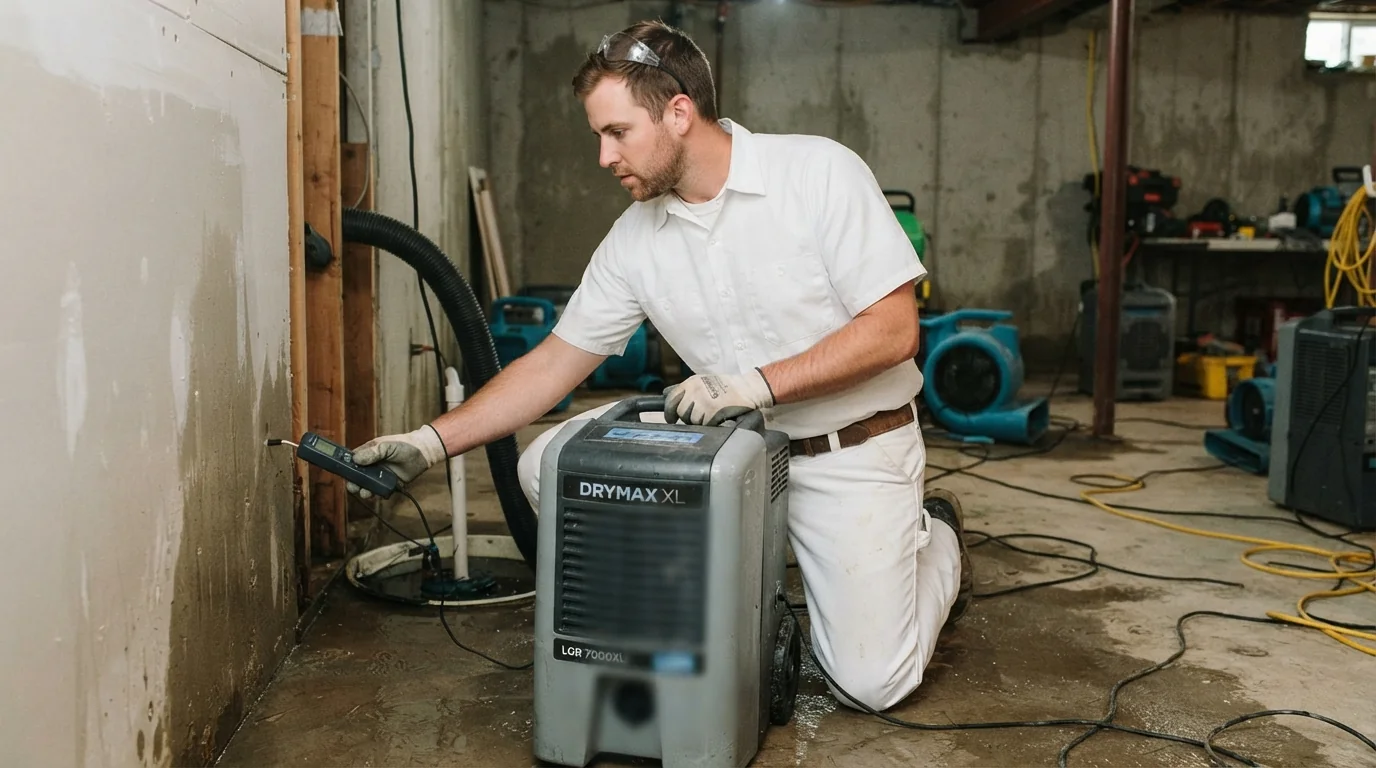
The correct number and capacity of dehumidifiers for a specific drying chamber is calculated based on the volume of wet materials in the space, the starting humidity and temperature conditions, and the evaporation rate produced by the air movers deployed. The IICRC S500 standard provides specific calculation methods for this sizing — the goal is to deploy dehumidification capacity that exceeds the evaporation rate by a sufficient margin to maintain a continuously downward trajectory in air humidity throughout the drying cycle. the IICRC S500 standard sets the procedural benchmark restoration companies are expected to follow. If cost is on your mind, how our pricing works breaks down what typically drives the number up or down.
Undersized dehumidification is one of the most common errors in restoration drying programs. A dehumidifier that is too small for the drying chamber reaches its capacity quickly and stops effectively removing moisture — the air humidity climbs, evaporation rate drops, and the drying program stalls.
Daily Grain Removal Monitoring
The daily monitoring of dehumidifier performance is as important as monitoring the moisture content of building materials. Technicians measure the grain-per-pound of moisture in the drying chamber air each day — ideally at the same time and location to ensure consistency.
Equipment moisture collection is also monitored: full collection tanks indicate that the dehumidifier is working at capacity and the drain system is functioning. If tanks are consistently near-empty after a full day of operation, it may indicate that the unit is not pulling moisture from the air effectively — potentially due to airflow restrictions, dirty filters, refrigerant issues, or incorrect sizing for the drying chamber conditions. the EPA provides background on how moisture control prevents mold growth in buildings. If you want to go deeper on this, our guide on How Injection Drying Systems Dry Walls Without Demolition covers it well.
The final stage of the drying program sees grain readings drop to a level consistent with pre-loss conditions in the property — typically within 2–5 grains per pound of the reference reading established before the loss. When grain readings at the measurement points in the drying chamber have stabilized at this level for 24 hours, and all material moisture readings have reached target levels, the drying program is complete.
Humidity Control After Restoration
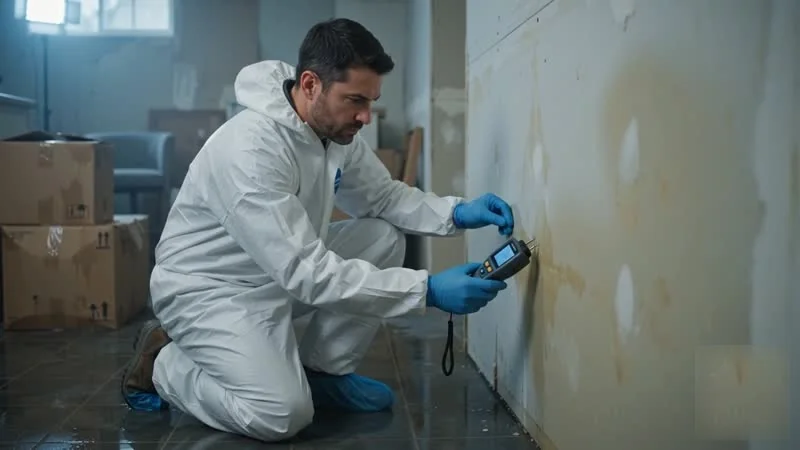
One of the questions homeowners ask at the conclusion of a structural drying program is whether they need to maintain specific humidity levels in the restored space going forward. The answer depends on the planned floor covering and reconstruction materials. FEMA's National Flood Insurance Program explains how the National Flood Insurance Program covers flood losses. We also break this down further in How Restoration Companies Maintain Extraction Equipment Between Phoenix Jobs.
For concrete slab floors awaiting resilient flooring (vinyl, tile, or engineered hardwood with adhesive), most manufacturers specify a maximum moisture vapor emission rate (MVER) from the concrete surface before installation. Professional restoration includes slab moisture testing at the conclusion of drying to confirm the slab meets the floor covering manufacturer's installation requirements — an important step that prevents adhesive failures and floor covering delamination months after installation.
Most Phoenix homes with tile flooring on concrete slab — the most common flooring configuration in the region — have no special ongoing humidity management requirement after restoration. Standard residential HVAC operation maintains adequate humidity control for these construction types.